A cake that collapses due to three grams too much, untranslatable “cups” that pop up in the middle of an American recipe, or that scale that gives up just before adding the flour. In the kitchen, switching from one unit to another sometimes feels like a tightrope walk where the slightest mistake tips the dish into the dark side.
The art of success then hinges on a pinch… perfectly calibrated. Between imperial and metric systems, mysterious abbreviations, and tips passed down through generations, everyone juggles with numbers and measurements. But how can one avoid turning the simple preparation of dinner into a puzzle, without ending up tearing their hair out in front of their mixing bowl?
Why do conversions in cooking often pose problems?
The conversion of measurements in cooking has a knack for turning whimsy into rigor, and vice versa. As soon as one moves from one country to another, from a blog recipe to an old family notebook, everything gets complicated: the measurement systems clash from one ocean to another. Cups, grams, pints, spoons… the waltz of units sets its tempo, and the cook must keep up without stumbling.
The slightest conversion error can disrupt the texture, balance of flavors, and success of the dessert. Add a bit too much yeast or not enough water, and the magic happens… in reverse. Precision becomes crucial, especially when it comes to baking or gluten-free recipes: there, every gram weighs heavily in the balance of success. Even search engines don’t solve everything: typing “25 cl to grams” doesn’t guarantee the exact answer, as each ingredient has its density, as noted on the page ’25 cl to grams: how to make the conversion easily – La Table de Jeanne’.
| Unit | Liquid | Flour | Sugar |
|---|---|---|---|
| 25 cl | 250 g (water) | 125 g | 220 g |
By multiplying sources and observing evolving domestic practices, the absence of a universal framework — despite the recommendations of the International Bureau of Weights and Measures — perpetuates confusion. Everyday cooking thus moves forward between tradition, tinkering, and uncertain standardization.
Simple guidelines to succeed in all your daily conversions
Some reflexes are worth their weight in gold: mastering the units is already winning a battle. One liter is 100 centiliters or 1,000 milliliters. For liquids, nothing replaces the graduated measuring cup, which allows you to read the desired volume directly, without hesitation.
- 1 tablespoon: 15 ml = 1.5 cl
- 1 teaspoon: 5 ml = 0.5 cl
- 1 standard glass: 20 cl
- 1 cup: 25 cl
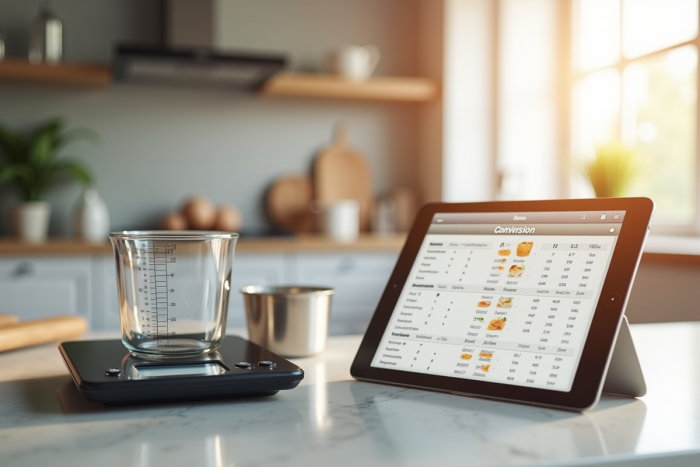
The kitchen scale remains the ally of the cook who wants to convert without a false note, especially for flour, sugar, or butter. Displaying a conversion chart on the inside of a cupboard door, or keeping an online converter handy, saves many hesitations.
For everyday recipes — pancakes, yogurt cake, sauces — here are a few conversions to memorize:
| Unit | Liquid | Flour | Sugar |
|---|---|---|---|
| 1 glass (20 cl) | 200 g (water) | 110 g | 180 g |
To convert milliliters to centiliters, simply divide by 10. But be careful: 250 ml does indeed equal 25 cl, but it will never equal 250 g of flour. Hence the importance of always relying on appropriate measuring tools — measuring cup, graduated spoons, scale — to measure accurately and avoid mishaps that spoil the fun.
In the kitchen, precision sometimes tastes like freedom: the freedom to succeed every time, without letting an unfortunate conversion sabotage the desire to share. It’s up to everyone to create their own score, armed with their references and the right measure.