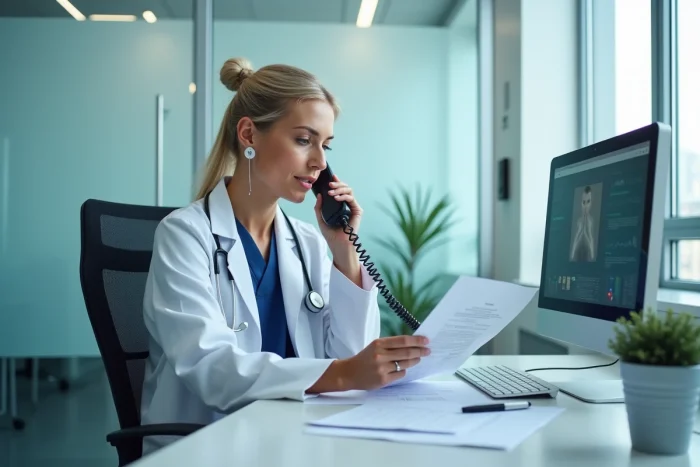
A on-call doctor receives a message on his pager, calls the service, reaches a voicemail, and eventually sends a text message to the night nurse. This scenario, still common in many French hospitals, illustrates a concrete problem: health communication channels overlap without real coordination.
Between historical tools and recent digital solutions, there is a fragmented landscape that directly impacts the quality of care and the fluidity of exchanges between professionals, as well as with patients.
Secure messaging in hospitals: replacing the pager with encrypted text
The pager is still used in many establishments, but its one-way functionality poses an obvious problem: it signals without providing context. The healthcare provider who is called back must guess the urgency, search for the right contact person, and sometimes call several extensions before obtaining the information.
Since 2023-2024, several hospitals in Switzerland and Germany have generalized encrypted instant messaging applications, integrated into the patient file. The principle: each message is time-stamped, tracked, and viewable in the clinical context of the concerned patient. Feedback shows measurable gains in response times between nurses and doctors, as well as a reduction in errors related to oral transmissions.
In France, adoption is slower. A detailed description of health communication channels can be found on Pharmidea, which maps these digital tools and their place in the current medical ecosystem. Secure messaging is not a gadget: it is a channel that transforms daily clinical coordination when properly deployed.
Patient portals: the non-urgent channel that absorbs phone calls
Calling your doctor for a blood test result, waiting twenty minutes on hold to renew a prescription: these situations generate frustration on the patient side and overwhelm medical secretariats. The patient portal provides a structured response to this problem.
In the UK, the Nordic countries, and Canada, patient portals have become the primary non-urgent communication channel between caregivers and patients. They include secure messaging with the practitioner, access to test results, prescription renewals, and sometimes asynchronous teleconsultation. Some hospitals now limit non-urgent requests by phone to direct traffic to this digital channel.
France is making progress in this area with Mon Espace Santé, but feedback varies on the actual usage rate by patients. The portal works well when it is simple, accessible on mobile, and when the response time from professionals remains reasonable. Without this, the patient returns to the phone.
What the portal changes for the professional
For caregivers, the patient portal is not just a comfort tool. It creates a systematic written record of non-urgent exchanges, which reduces misunderstandings and forgetfulness. Requests arrive asynchronously, allowing them to be processed in batches rather than interspersed between two consultations.
SMS and automated calls: the underestimated channel for home follow-up
We often think of sophisticated mobile applications for telemonitoring. In practice, the channels that work best for post-hospitalization follow-up and chronic disease management are often the simplest: automated SMS, scripted outgoing phone calls, interactive voice response systems.
These “low-tech” channels show significant results in therapeutic adherence and reduction of readmissions. Their strength lies in a practical observation: elderly populations or those uncomfortable with digital technology use SMS and phone calls without training. No app to install, no password to remember.
- The medication reminder SMS, sent at a fixed time, increases adherence among chronic patients without requiring an internet connection.
- The scripted outgoing call (an automated system asks three or four questions about symptoms) helps detect a deterioration before it leads to emergencies.
- The interactive voice response system provides the patient with an accessible reporting channel at any time, even without a smartphone.
These tools are not spectacular, but they cover a part of the population that patient portals and applications do not reach.
Social media and digital strategy in health communication
Social media play an increasingly important role in medical communication, but their use differs depending on whether addressing the general public or healthcare professionals. For establishments, social media primarily serve institutional communication and prevention: vaccination campaigns, health alerts, recruitment of healthcare staff.
For laboratories and medical marketing players, platforms like LinkedIn target professionals, while Facebook and Instagram reach patients and the general public. The difficulty lies in the regulatory framework: advertising for medications is regulated, communication about health data must comply with GDPR, and the line between information and promotion is closely monitored by authorities.
Internal communication vs patient communication: two distinct logics
These two dimensions are often mixed up. Internal communication (between caregivers, between departments) relies on secure, tracked tools integrated into hospital information systems. Patient communication uses more open channels, but with strong confidentiality constraints.
- Internal communication: encrypted messaging, computerized patient files, secure videoconferencing, structured transmissions.
- Communication to the patient: patient portal, SMS, postal mail for sensitive results, phone for medical announcements.
- Public communication: establishment website, social media, prevention campaigns, press relations.
Each channel meets a specific need. Establishments that try to funnel everything through a single tool end up creating bottlenecks or breaches in patient data confidentiality.
The choice of the right communication channel in health does not stem from a technological preference. It depends on the recipient, the degree of urgency, and the level of confidentiality required. A patient portal will never replace the surgeon’s call after a procedure, and an automated SMS cannot substitute for a structured nursing transmission. The right strategy is to assign each type of exchange to the most suitable channel, not to multiply tools hoping that one of them will eventually fit.