
Your tank is showing a low level, the temperature is dropping, and you’re hesitating to place an order. Knowing when heating oil prices will fall means understanding what actually makes up your bill—and which parts of it could move in your favor.
What you’re really paying for in a litre of heating oil
Before watching for a price drop, take a look at what makes up the price. A litre of heating oil is more than just a petroleum product: it’s a stack of costs, some of which barely ever change.
Take the TICPE (domestic tax on the consumption of energy products) and the CCE (climate-energy contribution). These two taxes are set at fixed amounts and don’t vary with the price of a barrel. When crude oil falls by a few dollars, fixed taxes absorb part of the drop before it reaches your bill. To better anticipate these changes, read this analysis on when heating oil prices will fall.
Add the refiner’s margin, the cost of delivery by tanker truck to your home, and the local distributor’s margin. As a result, the price of Brent crude accounts for less than half of the final price.
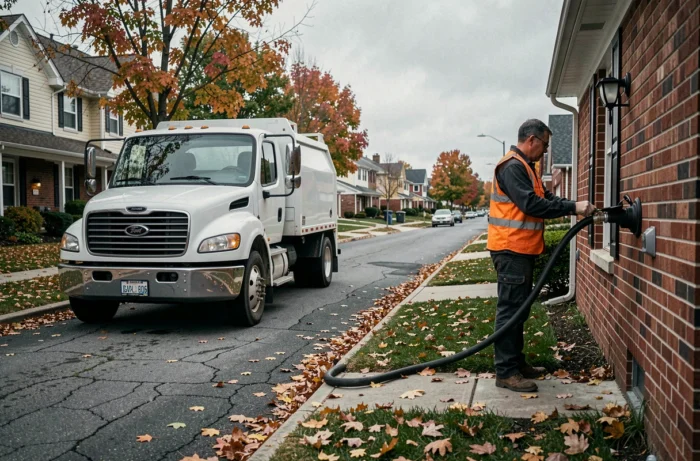
In practical terms, when the media report that the price of a barrel has fallen by five dollars, the price per litre delivered to your home doesn’t fall by the same amount. Only the “raw material” portion of the price responds to the global market.
Brent prices and OPEC+ decisions: two factors to watch
Brent is the benchmark price for crude oil traded in London. It sets the starting point for the entire supply chain. When it rises, heating oil prices follow, with a delay of a few days to a few weeks.
You may have noticed that Brent price drops take longer to feed through than increases. This delay has a simple explanation: distributors buy their stock at a given price and don’t sell it at a loss before it has been used up.
OPEC+ decisions—the cartel of oil-producing countries and their allies—have a direct impact on prices. When OPEC+ cuts its production quotas, global supply tightens and prices rise. Conversely, a gradual increase in OPEC+ production can ease prices, but it can take several months for the effect to reach French consumers.
Global demand also plays a role. An economic slowdown in China, the world’s largest oil importer, reduces demand for crude and pushes prices down. Geopolitical tensions, such as sanctions and conflicts in oil-producing regions, have the opposite effect.
Releasing strategic reserves: a real but limited price drop
The government has announced that it will draw on strategic petroleum product reserves to bring down the price of heating oil. France has maintained these stocks since the 1973 oil crisis, storing them in depots across the country.
The idea is to put volumes bought at a much lower cost than current market prices back on the market. A decree governs the operation and requires distributors to tell customers how much of a discount has been applied before the sale.
Be careful not to confuse this measure with a uniform discount. TotalEnergies, for example, announced a discount for its own network, but that doesn’t mean all distributors will apply the same amount. Each supplier passes on the reduction according to its own purchasing terms and margins.
- The decree requires distributors to pass on the reduction, but does not set the same minimum price for everyone.
- Tight supplies of refined products can persist even when crude oil supply recovers, limiting the size of the price drop.
- A forecast decline in crude oil prices over the medium term does not guarantee an immediate drop on your next delivery.
Check how much of the reduction your supplier is actually passing on
Rather than waiting for a theoretical nationwide price drop, check what your distributor is actually offering. The decree gives you leverage: ask for a breakdown of the discount before confirming your order.
Compare quotes from several local suppliers for the same volume. Price differences between distributors can reach several dozen euros per 1,000 litres, even in the same area. Local competition has a greater impact on your bill than a movement of a few dollars in Brent prices.

Not sure whether to order now or wait? Ask yourself two questions:
- How much heating oil is left in your tank? If you risk running out before the next available delivery, the cost of an emergency call-out will far outweigh any savings you might make.
- Has the heating season already started? Seasonal demand pushes prices up between October and January, which can cancel out the reduction from strategic reserves.
- Does your supplier offer a lower rate for larger orders? Buying in bulk with your neighbors can sometimes get you a better price than waiting for a hypothetical drop.
Heating oil in France: a shrinking market that remains under pressure
Today, heating oil is used to heat fewer than one in ten homes in France. According to INSEE data cited by the local press, that figure rises to nearly one in five in some rural departments, where older buildings are more common.
This disparity creates a paradoxical situation. Households that still depend on heating oil are often the ones with the fewest immediate alternatives: older homes, areas without access to mains gas, and limited budgets for switching to another heating system.
So while heating oil price changes affect a shrinking share of the population, those households are all the more vulnerable. For them, every cent per litre counts, and deciding when to fill the tank isn’t a matter of speculation—it’s a direct budget constraint.
Heating oil prices depend on a long supply chain, from the crude oil well to your tank, with every link taking its share. Keeping an eye on Brent prices is useful, but comparing local quotes and insisting on transparency about the discount applied will protect your budget better than a three-month forecast.