In the United States, a cup of flour corresponds to 120 grams, while in the United Kingdom, the same measurement rises to 140 grams. The French tablespoon measures 15 milliliters, compared to 14.2 milliliters for its American equivalent. Switching from one system to another exposes discrepancies that can alter the balance of a recipe.
Common mistake: confusing weight and volume, especially when converting liquids and dry ingredients. International recipes require precise mastery of equivalences, or else the results can be unpredictable.
What measurements in cooking hide: understanding units and their stakes in daily life
Conversion in cooking is never just a quick calculation. Behind every number, the mastery of units affects texture, balance, and even the final success. Moving from grams to milliliters, from liters to tablespoons, means anticipating the exact nature of the ingredient, its state, liquid or solid, and its impact on the result. Nothing is left to chance.
Precision in recipes relies on careful reading of measurements. Take sugar and flour: their density differs, so converting 100 grams of one or the other into milliliters does not yield the same volume. The question often arises: how to convert 300 g to ml when a recipe requires it immediately? The mention of 300 g to ml should always be accompanied by a reliable reference, as the density of water, milk, or oil varies from one ingredient to another.
Here are three points to keep in mind for cooking without mistakes:
- Measurement units structure the success of a pancake batter, a sauce, or a cake.
- Converting milliliters to centiliters or liters makes adjusting liquids simple and efficient.
- Considering the density of each ingredient helps avoid surprises and disappointing results.
Conversion in cooking then becomes a matter of rigor. It ensures reliable results, and for all those who love to cook, it is the key to a transferable know-how. Units are not a technical whim: they constitute the universal language that connects tradition and creativity, yesterday’s gesture and today’s innovation.

Concrete examples and clever tips: succeed in all your conversions without a headache
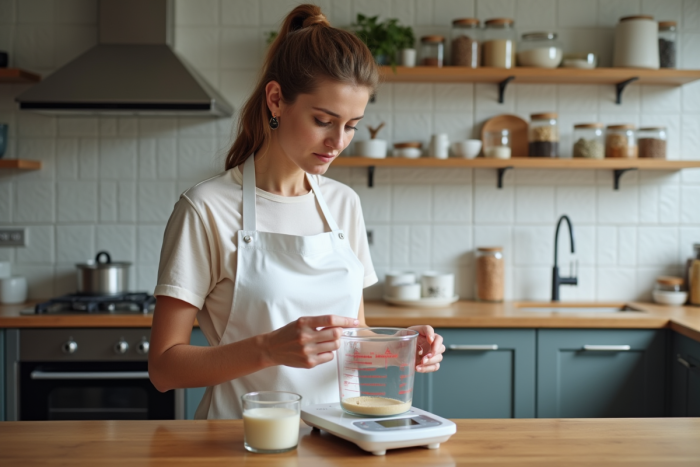
Measurement conversion in cooking comes to life in very specific situations: converting cups to grams, moving from tablespoons to milliliters, adjusting doses when the kitchen scale is missing. A conversion chart remains the best ally to know that 1 tablespoon equals 15 ml or that 1 cup of flour weighs 120 g. Small errors often creep in the details: baking powder or sugar do not have the same density as water. To ensure a consistent result, it is better to rely on the right tools: measuring cup, digital scale, measuring spoons. These tools help ensure successful and consistent preparations.
- 1 teaspoon = 5 ml
- 1 tablespoon = 15 ml
- 1 standard measuring cup = 200 ml
- 1 cup (US cup) = 240 ml
To go further, mobile conversion apps make the task even simpler: just enter the quantity, ingredient, and unit, and the equivalence appears instantly. These digital tools are welcomed in professional kitchens but also appeal to home enthusiasts. For technical preparations, such as choux pastry or emulsified sauces, every gram counts: precision makes the difference. Measure liquids in milliliters, solids in grams, and you will eliminate unnecessary approximations in one motion. Cooking is built on this attention to measurements, on this respect for details. And that’s where the magic happens, far from chance and guesswork.