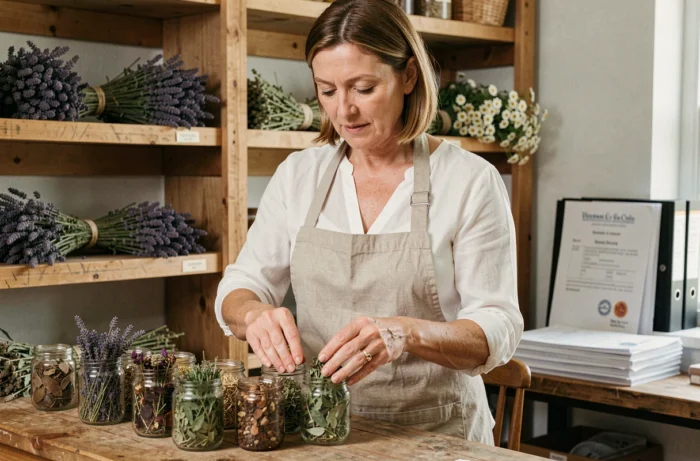
The sale of medicinal plants in France is based on a stack of texts that do not always overlap. The pharmaceutical monopoly, codified in Article L. 4211-1 of the Public Health Code, covers by default all plants listed in the Pharmacopoeia. Decree No. 2008-841 of August 22, 2008, freed 148 of them, but this liberation does not open up all uses.
It allows for sale as is, provided that the part of the plant and the form of preparation indicated in the text are respected.
Part of the plant and form of preparation: the two filters of the 2008 decree
We regularly observe project holders who consider the list of 148 plants as a blanket approval. This is a mistaken reading. The decree specifies, for each plant, the usable part (leaf, flower, flowering top, root) and the accepted form of preparation (as is, powder, etc.).
A common example: hawthorn is among the freed plants, but only the flower and flowering top are allowed outside of pharmacies. The berry remains under monopoly. Selling a hawthorn herbal tea made from berries exposes one to a violation of the pharmaceutical monopoly, even if the name of the plant appears in the decree.
Calendula poses a similar problem. Its flower is freed, but not its other parts. Each entry in the decree functions like a specification sheet: botanical species (Latin name), part, form. A deviation from any of these three criteria is enough to reclassify the product within the pharmaceutical field.
The question of the legal status suitable for this type of activity often arises; the regulation for selling medicinal plants requires cross-referencing commercial law with the health constraints specific to plants listed in the Pharmacopoeia.

Health claims on plants: what the DGCCRF really monitors
Any therapeutic claim is prohibited outside the pharmaceutical circuit. Stating that an herbal tea “cures insomnia” or “treats anxiety” shifts the product into the category of medicine by presentation, even if the plant is freed. The sanction does not depend on the product’s composition, but on the words used to describe it.
The health claims allowed on food products (including herbal teas sold as food) fall under European Regulation No. 1924/2006. In practice, most claims related to plants have been pending evaluation for years. Do not mention any health properties without prior verification of the European register of authorized claims.
The DGCCRF also controls labeling: trade name, ingredient list, part of the plant, batch, minimum durability date. An incomplete label constitutes an infringement independent of the product’s composition.
Plant-based dietary supplements: declaration and decree of 2014
Transforming a freed plant into a capsule, extract, or tincture no longer falls under simple food commerce. The product enters the category of dietary supplements, regulated by Decree No. 2006-352 of March 20, 2006. Market placement requires a mandatory declaration to the DGCCRF, not prior authorization as for a medicine.
The decree of June 24, 2014, constitutes the complementary reference. It lists the plants usable in dietary supplements species by species, with the admitted parts, composition restrictions, and mandatory warnings on labeling.
- The presence of a plant in the list of 148 freed plants does not imply automatic authorization for a dietary supplement: the two references are distinct and must be verified separately.
- Warnings for pregnant women, people on anticoagulant treatment, or children must appear on the packaging when provided for by the decree.
- In June 2023, Anses published an opinion listing the precautions for use, contraindications, and drug interactions of 118 plants used in dietary supplements, a reference document for calibrating labeling mentions.
Nutrivigilance and post-marketing reporting
The nutrivigilance system of Anses collects adverse effects reported by health professionals and consumers. The market operator must integrate this feedback into their regulatory monitoring. A repeated report on an ingredient can lead to a restriction of composition or a withdrawal of the 2014 decree.
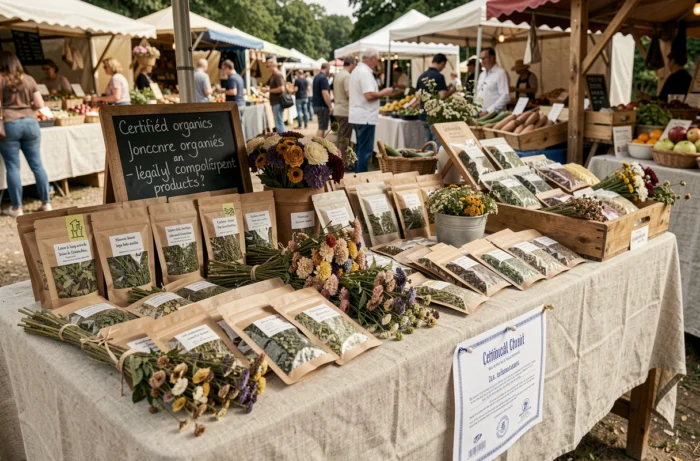
Sale of plant mixtures and cosmetics: separate regulatory frameworks
A herbal tea mixture composed exclusively of freed plants, sold as is, remains within the scope of the 2008 decree. However, as soon as a mixture includes a non-freed plant or a reserved part of a plant, the entire product falls under pharmaceutical monopoly.
For plant-based cosmetic products, the framework is entirely distinct: it is European Regulation No. 1223/2009 that applies. The same producer can sell the same plant under three different statuses (food, dietary supplement, cosmetic), provided that each regulation is respected independently. The plant does not have a unique status in French law: it is the declared use and presentation that determine the applicable regime.
- Loose chamomile herbal tea (flower, as is): free sale under food regime, reduced VAT.
- Chamomile extract capsule: dietary supplement, DGCCRF declaration, 2014 decree.
- Chamomile cream: cosmetic product, mandatory product information file (PIF), safety assessment by a toxicologist.
Each sales channel (market, shop, e-commerce) adds its own information and traceability obligations. Compliance is not verified once at launch: it must be maintained with every change in range, supplier, or formulation.
The most underestimated point remains the responsibility in case of adverse effects. Without correct declaration, without compliant labeling, and without monitoring Anses’ opinions, a producer or reseller exposes themselves to administrative and criminal sanctions that far exceed a simple formal notice.